Symptoms
This section focuses on the different symptoms associated with Huntington's disease.
Movement
One of the main movement impairments associated with HD is hyperkinesia, referring to excessive movement and muscular activity. Dyskinesia also occurs, which is involuntary movement. These types of movement disorders are known as chorea.
The following movement disorders also occur:
-loss of coordination and balance
-jaw clenching and slurred speech
-swallowing and eating disorders
-dystonia; uncontrolled muscle contractions
-walking difficulties, stumbling and falling
These changes in movement occur due to the neurodegeneration of the caudate nucleus, putamen and globus pallidus, which leads to a loss of inhibition to the thalamus, and therefore uncontrollable movement.
Cognition
Some cognitive symptoms have a gradual onset, whereas others occur in an acute fashion.
Early stages of the disease affect concentration, attention, visuospatial abilities, emotion recognition- particularly facial expressions and voices relating to disgust, and 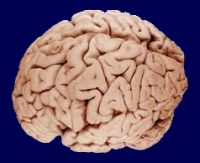 memory. Tests that demonstrate psychomotor functioning, reading and the naming of colours, and executive functions and planning show a strong decline over time.
These symptoms become more severe as the disease progresses, and problems in planning, problem solving, cognitive flexibility and also concentration become more apparent. Visuospatial skills also grow steadily worse throughout the progression of the disease; as do memory problems, which can result in impairments in long- and short-term memory, for either declarative or procedural memory tasks. A retrieval-based memory deficit has been shown to be due to frontostriatal dysfunctions.
Photograph of the human brain. Image courtesy of commons.wikimedia.org/wiki/File:Brain_090407.jpg under the Creative Commons Attribution 3.0 Unported licence.
These cognitive impairments gradually turn into dementia, key elements of which involve a decrease in motivation, slower processing and depression. This can eventually lead to difficulty in decision-making and a failure to recognise objects.
These changes are associated with changes in the caudate nucleus, globus pallidus and putamen, as well as changes in the grey and white matter of the cortex. Some studies have shown a decreased volume of the brainstem, hippocampus and entorhinal cortex, and of the overall brain. A decrease in memory function, executive functions and verbal associative learning has been correlated with a decrease in glucose utilisation in the striatum.
Specific cognitive changes have been linked to alterations in the caudate nucleus and putamen, whereas an impairment of psychomotor and executive functions is associated with changes in the basal ganglia affecting the fronto-striatal cortex.
Psychiatric
The majority of HD patients suffer from depression early-on which can progress with the disease.
Psychotic behaviour can also develop including delusions, hallucinations and paranoia.
Late-onset HD
In these patients, depression can occur rather than anger, and their memory, reasoning and problem-solving skills can remain at the same level.
Juvenile HD
As Juvenile HD occurs at a much earlier age, the first signs of the neurodegenerative disorder can appear in, for example, handwriting skills or poor performance at school. These are then followed by behavioural and personality changes, as well as the associated movement disorders.
Children under the age of 15 often suffer from seizures and muscle stiffness and rigidity (akinesia).
Cause of Death
HD itself does not kill directly, but the associated complications do. Affected individuals are often bedridden in the later stages of the disease which can lead to heart complications and pneumonia, leading to death.